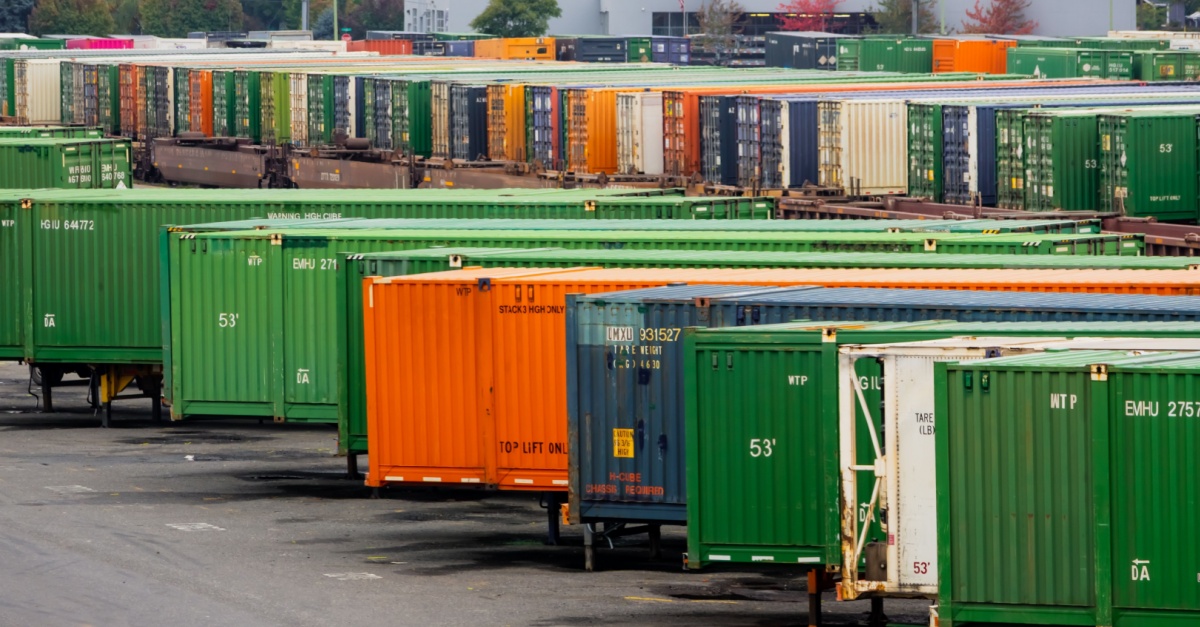

Today’s supply chains face global disruptions, fluctuating capacity, and rising transportation costs. This is reshaping how freight moves, forcing companies to rethink their logistics strategies.
For many, intermodal transportation has become the key to building efficiency and resilience in the face of shifting trade policies, economic uncertainty, and carrier actions in response. According to the Intermodal Association of North America (IANA), domestic intermodal volume was up 5.8% in September year over year.
VCPB Transportation, a full-service logistics provider with more than three decades of experience, helps businesses integrate rail, truck, and ocean into a single, coordinated network. With deep expertise, advanced visibility tools, and a proactive operations team, VCPB makes intermodal shipping not just possible but seamless.
Intermodal logistics links the strengths of each transportation mode into one cohesive solution. Trucks handle local pickup and delivery, rail moves freight long distances at lower cost, and ships carry large volumes across oceans. Together, they form a system that balances speed, flexibility, and cost efficiency.
For manufacturers, intermodal supports stable material flow to plants and distribution centers. For e-commerce and retail businesses, it provides predictable long-haul replenishment while preserving fast final-mile delivery. And for importers and exporters, it creates a smooth, end-to-end path between ports, terminals, and inland destinations, reducing dwell time and improving schedule reliability.
The growing importance of intermodal transportation reflects a broader trend: Companies want supply chains that can adapt to shifting conditions without sacrificing cost control or service quality.
Intermodal is cost efficient. Rail transport offers a lower cost per mile than over-the-road trucking, particularly for shipments traveling more than 500 miles. By combining rail’s scale with trucking’s flexibility, shippers reduce linehaul expenses while maintaining reliable service. Containerized freight minimizes handling, further cutting costs and transit risks.
Sustainability is another benefit. Intermodal networks contribute meaningfully to sustainability goals. Trains are far more fuel efficient than trucks, reducing greenhouse gas emissions and lowering a company’s overall carbon footprint. As environmental targets become integral to business performance, intermodal solutions help companies demonstrate measurable progress.
Reliability is built into intermodal. With highway congestion and driver shortages continuing to strain capacity, rail-supported routes offer a dependable alternative. Containerized interchanges between modes protect freight from damage and reduce the chance of missed connections. Predictable schedules make it easier to plan inventory and meet delivery promises.
An integrated intermodal network is also resilient. When one mode faces disruption, such as a weather event or port delay, the network can shift capacity or reroute shipments more easily. That flexibility keeps supply chains running when single-mode systems stall.
Achieving intermodal efficiency requires precise coordination. Each mode operates with different schedules, technologies, and service providers. Without a unifying strategy, shipments can lose visibility as they transition between carriers.
The complexity increases as volumes scale. That’s why successful intermodal logistics depends not just on the modes themselves but on the partner who manages them.
VCPB Transportation eliminates the friction between transportation modes through a combination of real-time technology, strong partnerships, and an experienced team.
A unified tracking system provides real-time updates for every shipment, across every mode. Customers see where their freight is, how it’s performing, and when it will arrive, all in one platform.
VCPB maintains long-standing relationships with rail operators, ports, and regional carriers. These connections ensure equipment availability, faster interchanges, and consistent service, even when capacity tightens.
VCPB’s operations specialists oversee scheduling, drayage, transloading, and documentation from start to finish. They identify potential disruptions early and take corrective action before customers feel the impact.
By integrating directly with customer systems, VCPB synchronizes order data, forecasts, and performance metrics. Predictive analytics highlight potential bottlenecks, while automation streamlines communication between stakeholders.
This combination of tools and talent transforms a traditionally fragmented process into a transparent, predictable supply chain.
VCPB offers confidence as well as access to capacity:
Our goal is to integrate transportation modes into a single, high-performing ecosystem.
The logistics industry is moving toward smarter, more connected networks where visibility, sustainability, and collaboration define success. As technology bridges the gap between modes, the trend is toward creation of a unified, data-driven supply chain.
VCPB Transportation empowers shippers to navigate that future with confidence. By merging cutting-edge tools with decades of operational know-how, VCPB turns multimodal complexity into a source of competitive advantage for shippers.
Intermodal success begins with integration. VCPB Transportation can work with you to build a supply chain that’s cost effective, transparent, and ready for anything the market brings. Start shipping smarter today.
VCPB Transportation
600 Meadowlands Pkwy Secaucus, NJ 07094
(201) 770-0111