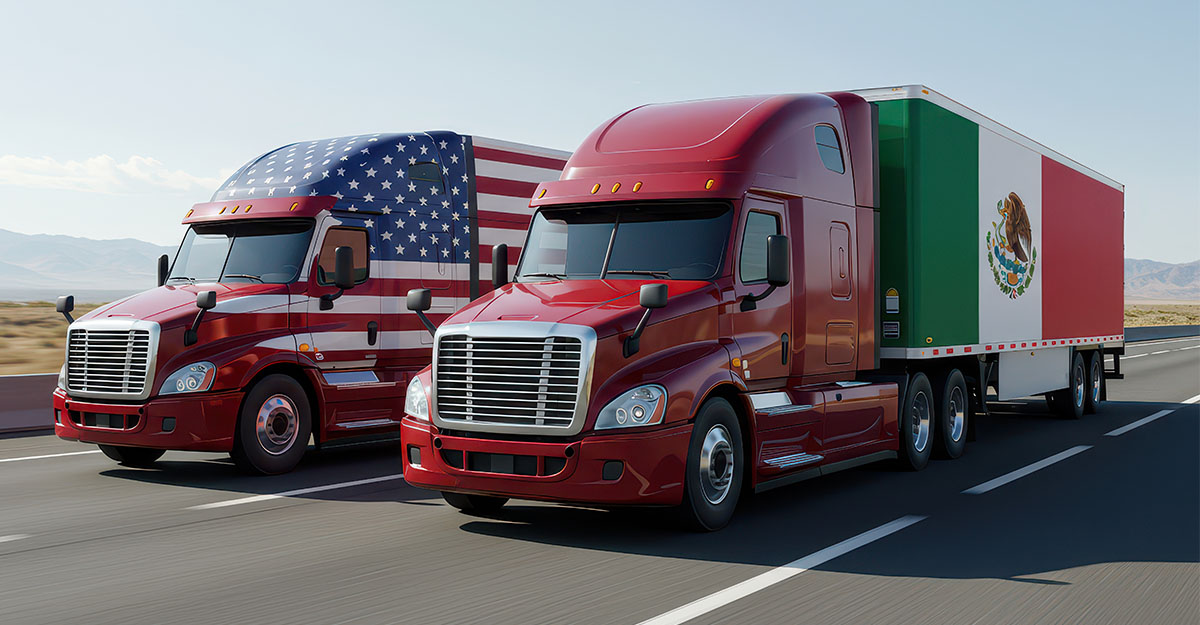

Global trade policy is shifting faster than at any point in the last decade, creating ripple effects across North American freight flows. As tariffs evolve and trade tensions roil markets, manufacturing footprints are shifting in response. At the same time, consumer expectations continue to accelerate.
The result is a cross-border logistics environment defined by constant change. Tariffs, nearshoring, and rising service expectations are reshaping how freight moves between the U.S., Mexico, and Canada. Shippers that adapt their strategies now will be positioned to compete more effectively in the years ahead.
Increased tariffs and ongoing trade tensions have influenced freight patterns across both U.S.-Mexico and U.S.-Canada corridors. Policy shifts — whether tied to sector-specific duties, enforcement actions, or broader geopolitical disputes — create uncertainty that affects sourcing, production, and transportation decisions.
Court rulings and regulatory clarifications also play a role. Everyone is awaiting the U.S. Supreme Court’s action on Trump’s constitutional authority to unilaterally impose tariffs under IEEPA, and must stay alert to shifts in legal interpretation that could affect duty exposure or compliance requirements. Even when policy reversals are debated or delayed, the uncertainty itself can influence shipping strategies.
Tariffs alter more than landed cost calculations. They influence where companies manufacture, how much inventory they hold, and which routes they prioritize. A modest duty increase on one component can trigger a larger shift in sourcing geography. When production moves, freight volumes follow.
These changes affect cost structures and transit times. Shippers may shift sourcing from overseas suppliers to North American partners, increasing cross-border truck and intermodal volumes. They may increase expedited shipments to offset disruptions or diversify suppliers to reduce concentration risk.
To navigate tariff-driven volatility, shippers need real-time visibility into shipments and flexible routing options that allow them to pivot quickly. Static networks struggle in a policy environment that continues to evolve.
In response to both tariffs and broader supply chain disruptions, many companies are moving production closer to North American consumers. Nearshoring has accelerated across key industries, including automotive, electronics, medical devices, and consumer goods.
Mexico has emerged as a central hub in this shift. Its proximity to the U.S., competitive labor costs, and established manufacturing base make it an attractive alternative to longer global supply chains. As a result, cross-border truck volumes have grown steadily, placing additional pressure on ports of entry and transportation infrastructure.
For this reason, major border crossings in Texas, Arizona, and California are experiencing higher volumes. Capacity constraints, inspection delays, and infrastructure limitations require more careful planning and coordination.
Nearshoring is also reshaping traditional freight corridors. While established lanes between central Mexico and the U.S. Midwest remain strong, new corridors are developing to serve emerging industrial clusters. Distribution networks must adjust accordingly.
For shippers, this means rethinking network design, carrier selection, and cross-border coordination. Growth in nearshoring creates opportunity, but it also introduces complexity.
While the broad frenzy around universal same-day delivery has eased, expectations around reliable, predictable delivery and clear visibility remain high. Even in cross-border contexts, e-commerce buyers and B2B customers alike expect timelines that match their promises and transparency that reduces uncertainty.
Omnichannel fulfillment models require inventory to be positioned closer to end customers. Retailers and manufacturers must balance speed with cost while maintaining service consistency across regions.
These pressures are leading shippers to reevaluate distribution strategies. Some are expanding cross-dock operations near the border. Others are increasing regional warehousing to buffer against delays. Mode flexibility has become critical.
Truckload, LTL, intermodal, and expedited services each play a role in meeting evolving service expectations. The ability to shift modes based on urgency, cost, and capacity conditions is increasingly valuable.
Today’s cross-border environment presents both operational challenges and strategic opportunities. Congestion at major ports of entry requires smarter routing and careful appointment management. Carriers must maintain strong compliance and safety programs to reduce inspection risk and avoid costly delays. Regulatory requirements, documentation standards, and customs coordination continue to grow more complex.
At the same time, lane optimization and consolidation strategies can unlock meaningful cost savings. Multimodal planning allows shippers to balance speed and efficiency. Strong carrier relationships reduce volatility in tight markets.
To remain flexible and cost-efficient, shippers should diversify sourcing and routing strategies to reduce exposure to sudden policy swings. Overreliance on a single lane or border crossing increases risk.
They should strengthen relationships with cross-border specialists rather than relying on ad hoc capacity. Consistency and familiarity improve performance, especially during disruptions.
Real-time visibility tools and data-driven planning are also essential. When shippers have access to accurate, timely information, they can make faster decisions that protect service levels and margins. In an environment shaped by policy shifts and infrastructure pressures, agility is a competitive advantage.
VCPB Transportation brings deep experience across U.S.-Mexico and U.S.-Canada freight lanes. Our cross-border expertise includes customs coordination, bilingual operations teams, thorough carrier vetting, and strong compliance oversight.
We understand the complexities of documentation, inspections, and regulatory requirements. Our flexible capacity solutions are designed for volatile markets where conditions can change quickly.
Through technology-enabled visibility and proactive communication, VCPB helps shippers maintain control over their cross-border freight. Our customer-first approach focuses on helping clients stay agile, efficient, and competitive as trade dynamics evolve.
Whether supporting nearshoring strategies, adapting to tariff changes, or meeting consumer-driven speed expectations, VCPB delivers customized solutions that turn cross-border challenges into strategic advantages.
Trade policy, nearshoring, and consumer expectations are reshaping freight flows across North America. The companies that adapt their networks, diversify their strategies, and invest in strong partnerships will be better positioned for long-term resilience.
VCPB Transportation supports shippers in navigating this new landscape. We help customers respond quickly to policy shifts, build reliable cross-border capacity, and meet rising service expectations with confidence. Start shipping with VCPB today and we’ll help you build a cross-border strategy that can address current and future cross-border logistics challenges.
VCPB Transportation
600 Meadowlands Pkwy Secaucus, NJ 07094
(201) 770-0111